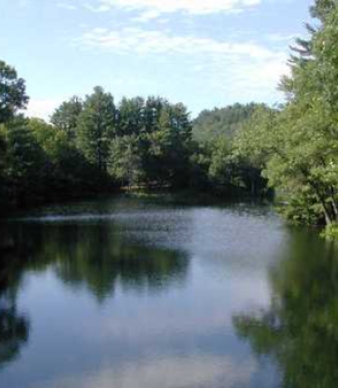
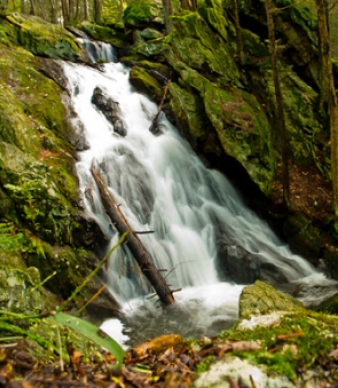
With miles of rugged trails, rich biodiversity, historical landmarks, and acres of natural beauty, Mattatuck offers a wide variety of forest experiences in close proximity to the Waterbury region. Various trails lead hikers past interesting topography to excellent overlooks while hunters, in season, flock to the forest for its wide variety of wildlife.
The forested corridor of Mattatuck lends a woodland aesthetic to the scenic drive along the Naugatuck River and provides a transition from the more industrial/urban landscape of the Naugatuck Valley to the “quieter” countryside of the Litchfield Hills. It also stands as a sure sign of nature’s resilience and of the determination of resource managers and conservationists.
The Legend of the Leatherman Lives On
Connecticut’s legend of the Leatherman is alive and well in Mattatuck State Forest. This renowned tramp frequented the forest in his baggy, 60-pound leather suit on his 34-day, 365-mile loop through western Connecticut and eastern New York. He faithfully followed this loop for roughly three decades until his death in 1889. Each day ended 10 – 11 miles from the last, and his long series of evening rest areas included many cave shelters and rock overhangs. One of these was, and still remains, in Mattatuck State Forest.
Overview/History
Mattatuck State Forest is the reality of Mr. Harley F. Roberts’s vision and the initial 723-acre land donation from his Black Rock Association in 1926. Mr. Roberts’s legacy of land conservation continues to this day. In the 85 years since his original gift, Mattatuck has grown to encompass 4,510 acres in 20 different parcels within the towns of Waterbury, Plymouth, Thomaston, Watertown, Litchfield, and Harwinton.
But the forest we see today is not the forest Mr. Roberts knew. There is an ironic truth about Connecticut forests: many of today’s most treasured and scenic locales are a product of yesterday’s disturbance on a grand scale. Mattatuck State Forest is no exception. Roberts saw a landscape that had been repeatedly clearcut to feed to the furnaces of the Naugatuck Valley’s brass industry. Subsequent unchecked recreational use left the area’s signature hills rapidly eroding into the valleys. Frequent forest fire activity further undermined the forests’ health.
Fortunately, the forest began to improve under the practices of the Civilian Conservation Corps (CCC). From 1933 until 1942 Camp Roberts was home to hundreds of unemployed young men who labored to turn the abused landscape into productive woodlands, stabilize the slopes, and stop the erosion. Finally, with the protection of the state park and forest system, the incidence of fire was reduced and sound long-term forestry management practices were put into place.
Though today’s forest hides many of the scars of the past’s resource extraction, signs of the region’s industrial history can still be found, including remains of quarries, lime kilns, house foundations, agricultural fields, and charcoal mounds.